
The massive heatwave that has claimed thousands of lives across Europe poses another serious challenge – devastated ecosystems and active risk of desertification.
Looks like the Bonn Challenge saw this coming.
What is the Bonn Challenge?
This was launched by the International Union for Conservation of Nature (IUCN) and Germany in 2011 with the aim to restore 150 million hectares of deforested land by 2020 and 350 million hectares by 2030. It is remarkable being one of the world’s largest collaborative environmental restoration efforts which found support from many countries globally.
Some interesting facts about the Bonn Challenge: Relies on FLR, the Forest Landscape Restoration, a framework that balances ecological health with human well-being through a combination of biodiversity conservation with sustainable land use. Restoration, under the Challenge, is not just about planting trees, but also includes agroforestry, natural regeneration, mangrove restoration, and climate-smart agriculture.
The India scenario
India has successfully achieved the initial Bonn Challenge target of restoring over 21.76 million hectares of degraded and deforested land and is on track to meet the second target of restoring an additional 5 mha by 2030.
In 2015, India undertook one of Asia’s largest pledges to restore 13 mha of degraded and deforested land by 2020 and an additional 8 mha by 2030. India’s 2030 target has since been enhanced to 26 mha. Prime Minister Narendra Modi has declared the intent to meet the restoration target in September 2019 at the COP 14.
Among the states of India, Telangana stands at the top of the charts of land restoration, followed by Madhya Pradesh, Odisha, and Gujarat.
Land and water
While land restoration seems to be on track, we need to focus on water as well. This has become especially important since the southwest monsoon this year opened with a severe deficit of around 40 percent in June putting agriculture under immense stress. To tackle a looming problem, we need to immediately activate dried up or disappeared ponds throughout the land.
Mission Amrit Sarovar, launched by the Government of India, targeted rejuvenating at least 75 water bodies in every district of the country. While the original goal was 50,000, the mission outdid itself with 68,000. Though many states including Kerala fell behind the national project as per some reports, some say it was implemented successfully. Then Kerala has its own pond development and rejuvenation schemes under Haritha Keralam Mission and Ente Kulam Projects which tap into public participation and CSR funds for its work. Faced with a scorcher of a summer in all possibility, we need to revive as many ponds as possible – both architecturally and technique-wise, where we can.
Some lessons from around us
Kannur: The multi-layered stone steps that mark the Sree Peralassery Subramanya Temple pond which allow water access over different seasons.
Thiruvananthapuram: The Vetubali Pond in Pallichal panchayat has water directed into it from the Neyyar Dam through a canal ensuring supply during summer months.
How about: An official body to scientifically identify old quarry pits to store water that can be used to irrigate nearby farmlands during water scarce seasons?
Here is hoping we can come up with our own ‘pond challenge’ – and surpass it before it is too late.
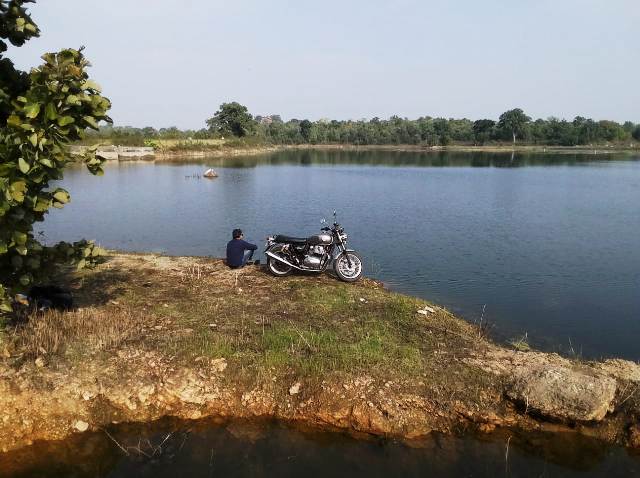
(An original Farmfrnd article. The image is me resting by a pond somewhere in Telangana during my motorcycle ride from Delhi to hometown Pala.)